
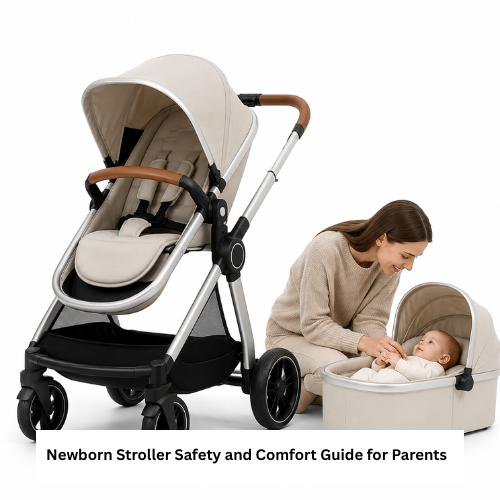
A newborn stroller should support a young baby with the right recline, comfort, safety setup, and compatible seat or bassinet design. Before buying, parents should verify whether the stroller is suitable for newborn use and whether it fits their daily routine.
Newborns need more support than older babies, so parents should not choose only by color, price, or design. A stroller for newborn use should be checked for recline, harness, brakes, canopy, bassinet support, and car seat compatibility.
Parents comparing first-stroller options can use online baby strollers to review stroller categories, bassinet options, travel systems, and baby accessories.
Why Newborn Use Needs Extra Checking
A stroller that works for an older baby may not be suitable for a newborn. Very young babies need proper head, neck, and back support.
Parents should check whether the stroller has a flat or near-flat recline, compatible bassinet, or infant car seat setup. If the listing does not clearly mention newborn use, verify before buying.
Newborn Stroller: What Parents Should Check
When choosing a newborn stroller, check age guidance, recline position, harness design, seat padding, canopy coverage, wheel stability, brake function, and whether the stroller can work with a bassinet or infant car seat.
A budget-friendly stroller for newborns can be reviewed when parents want comfort and safety checks without choosing only by price.
Do not assume every reclining stroller is newborn-ready. Some seats recline, but still may not provide the right support for early use.
| Feature | Why It Matters | What to Verify |
| Recline position | Supports younger babies | Flat or newborn-approved recline |
| Bassinet option | Helps with early resting setup | Compatibility and attachment method |
| Harness | Helps secure the baby | Fit, adjustment, product guidance |
| Canopy | Helps with shade | Coverage, ventilation, extension |
| Brakes | Keeps stroller steady | Locking method and ease of use |
| Wheels | Affects smooth movement | Stability, turning, surface suitability |
| Car seat compatibility | Helps with travel systems | Exact model match and adapters |
Bassinet and Carrycot Options
A bassinet stroller can be useful for early months when parents want a flatter resting setup. Some strollers include a bassinet, while others require a separate attachment.
Parents can compare baby stroller bassinets and carrycots when checking newborn comfort and resting options.
Always confirm that the bassinet fits the stroller frame. Do not assume that every bassinet from the same brand fits every stroller.
Infant Stroller and First Stroller Choices
An infant stroller should match your baby’s age, your car travel needs, and your storage space. Some parents prefer a pram-style stroller, while others need a newborn travel system.
If you want a product-level comparison, a folding infant newborn pram stroller can be checked for foldability, newborn support, and pram-style design.
For outside comparison, a bassinet stroller can help parents compare recline, resting setup, and early baby travel features before ordering.
Travel System and Car Seat Notes
A newborn travel system may be useful if you move often between car and stroller. It can help with short transfers when the car seat and stroller are compatible.
Parents can review newborn travel system options when comparing car seat stroller compatibility for early baby travel.
Compatibility is important. Verify the exact car seat model, stroller frame, adapter, base, and product guidance before buying.
Safety Checks Before Daily Use
Baby stroller safety should be reviewed every time you use the stroller, especially for newborns.
Check:
- Brakes before placing baby inside
- Harness position
- Recline setting
- Frame lock
- Wheel movement
- Canopy position
- Car seat or bassinet attachment
- Product age and weight guidance
Avoid hanging heavy bags on stroller handles because this can affect balance.
Setup and Maintenance Tips
Before the first walk, practice opening, folding, braking, and adjusting the harness. Read the product manual and keep it available for future checks.
Maintenance should include cleaning spills, removing crumbs, checking wheels, wiping the frame, and inspecting brakes and buckles.
If the stroller feels unstable, does not lock properly, or has damaged parts, stop using it until the issue is checked.
Common Buying Mistakes
Parents often make these mistakes:
- Buying a stroller without confirming newborn use
- Ignoring car seat compatibility
- Not checking folded size
- Choosing a stroller that is too heavy
- Assuming all bassinets fit all frames
- Not checking cleaning instructions
- Forgetting return policy details
If a product-specific detail is not confirmed, verify before buying.
Practical Buying Checklist
Before buying a newborn stroller, check:
- Newborn suitability
- Recline position
- Bassinet compatibility
- Infant car seat compatibility
- Harness setup
- Brake function
- Wheel stability
- Stroller weight
- Folded size
- Storage basket
- Canopy coverage
- Cleaning guidance
- Warranty or support details
- Return policy
- Delivery details
- Verify before buying if compatibility is unclear
Conclusion
A newborn stroller select with safety, comfort, recline, bassinet support, and compatibility in mind. Parents should review product guidance carefully before buying so the stroller fits newborn needs and everyday family travel.
FAQ
What should I check in a newborn stroller?
Check newborn suitability, recline, harness, brakes, bassinet support, car seat compatibility, and product guidance.
Can a regular stroller be used for a newborn?
Only if the stroller is approved for newborn use. Some regular strollers are meant for older babies.
Is a bassinet stroller useful for newborns?
It can be useful if it is compatible and designed for newborn support.
Do I need a newborn travel system?
It may help if you often move between car and stroller. Check exact car seat and stroller compatibility.
Why is recline important for newborns?
Newborns need proper support, so recline and seat structure should match the product’s newborn-use guidance.
